


Table of Contents
- Why Lead in Old Tubs Matters Before Reglazing
- Is Bathtub Refinishing Safe for Family? What Lead Protection Really Means
- Lead Paint Testing Kits for Bathtubs: What They Can and Cannot Tell You
- Professional Bathtub Refinishing Safety Standards Toronto Homeowners Should Expect
- Encapsulation Versus Removal: Which Protects Best Against Lead in Old Tubs
- Choosing a Lead-Safe Refinishing Provider in Toronto
- Frequently Asked Questions
Last Updated: September 24, 2026
Why Lead in Old Tubs Matters Before Reglazing
The best protection against lead in old tubs for bathtub reglazing is encapsulation: sealing the lead-bearing surface under a bonded coating rather than stripping it out. Homes built before the mid-1970s commonly have cast iron tubs finished with enamel that can contain lead, and sanding or grinding those surfaces without controls spreads dust through the whole bathroom. At Century BathTubs, we have handled refinishing work across Toronto and the GTA since 1995, and a common question we hear is simple: will the new coating actually lock the old finish down? The short answer is yes, when the prep is done correctly and the coating bonds fully. Below, we break down what lead protection really means, how the two main methods compare, and what to demand from any provider you hire.
Is Bathtub Refinishing Safe for Family? What Lead Protection Really Means
Bathtub refinishing is safe for a family when the lead-bearing surface is sealed rather than disturbed, and when dust controls are used during prep. Lead protection is the practice of containing or covering lead-based finishes so they cannot become airborne dust or contaminate surfaces your family touches.
Two things matter most. First, intact lead paint or enamel is not an immediate hazard; disturbed lead is. Second, the risk peaks during preparation, not after the coating cures.
- Containment: plastic sheeting and sealed doorways keep dust inside the work zone.
- Wet methods: damp sanding and wiping suppress airborne particles instead of scattering them.
- Ventilation: exhaust fans and open windows move air out, not through the rest of the home.
- Cleanup: HEPA vacuuming and wet mopping after the job removes residue that settles on floors and fixtures.
Health Canada advises that lead exposure is most dangerous to young children and pregnant women, and that renovating surfaces painted with lead-based paint is a common source of household exposure. If your tub predates the 1970s and you are unsure about its finish, treat it as lead-bearing until testing says otherwise.
The most common mistake is dry-sanding an old tub to “rough up” the surface before coating. That single step can release lead dust across the bathroom and into adjacent rooms.
Encapsulation Versus Removal: How Each Method Works
Encapsulation coats the existing surface and bonds a new finish over it, sealing the lead in place. Removal strips the old finish down to bare cast iron or steel, which eliminates the lead but generates far more dust and debris. Encapsulation is the standard approach for occupied homes because it keeps the hazard contained. Removal is sometimes necessary when the old finish is failing badly, but it belongs in a controlled setting with full containment. Century BathTubs uses an EP-ACRYLIC coating system that cures fast and bonds directly to prepared surfaces, which is why encapsulation works as lead protection in practice.
Lead Paint Testing Kits for Bathtubs: What They Can and Cannot Tell You
Lead paint testing kits for bathtubs give you a fast yes-or-no read on whether a surface contains lead, but they cannot tell you how much lead is present or how deep it goes. Most kits use a swab that changes colour on contact with lead. They are a screening tool, not a lab result.
What they do well:
- Confirm the presence of lead on an exposed enamel or paint surface
- Give a quick answer before you commit to a renovation plan
- Cost little and require no special training
What they miss:
- They only test the spot you swab, so a negative result on one patch does not clear the whole tub.
- They cannot measure concentration, which matters for deciding how much containment you need.
- They do not detect lead beneath multiple layers of old finish.
For a definitive answer, a certified laboratory analysis is the reliable route. For a fast pre-renovation check, a swab kit is a reasonable first step.
How to Test Your Tub in Four Steps
- Choose a worn or chipped area where the original finish is exposed, not a spot covered by newer paint.
- Clean the test spot and let it dry fully; moisture and grime can skew a swab result.
- Follow the kit instructions exactly, usually by squeezing the swab and rubbing it on the surface for the stated time.
- Read the colour change against the kit’s chart and photograph the result before you start any work.
If the swab turns positive, stop and plan for encapsulation with proper containment. If it is negative, test one or two more spots before you treat the tub as clear.
Professional Bathtub Refinishing Safety Standards Toronto Homeowners Should Expect
Professional bathtub refinishing safety standards in Toronto should include sealed work zones, wet prep methods, HEPA cleanup, and technicians who are licensed and insured. Those four elements separate a controlled job from a risky one.
Ontario’s Occupational Health and Safety Act sets duties for employers and workers around hazardous substances, and refinishing chemicals fall under that framework. A provider working in an occupied home should also be able to explain how they keep dust out of the rest of the house.
What to ask before you book:
- Are your technicians licensed and insured, and can you show proof?
- How do you contain dust during preparation?
- What coating system do you use, and how long does it take to cure?
- What guarantee covers the finished work?
Century BathTubs has operated in the Toronto area since 1995 with trained, licensed, and insured technicians, and every job carries a three-year hassle-free guarantee. That combination is what a homeowner should be looking for when comparing providers near me.
Ask for the containment plan in writing. A provider who can describe exactly how they seal doorways, protect the floor, and clean up afterwards has done this in occupied homes many times. Vague answers are a warning sign.
Encapsulation Versus Removal: Which Protects Best Against Lead in Old Tubs
Encapsulation protects against lead in old tubs for most homes, because it seals the lead-bearing finish in place instead of disturbing it. Removal eliminates the lead entirely, but the dust and downtime can make it a less suitable fit for a bathroom your family uses daily.
| Factor | Encapsulation | Full Removal |
|---|---|---|
| Dust generation | Low, contained | High, extensive |
| Downtime | Short, often same day | Multi-day |
| Long-term protection | Sealed under bonded coating | Lead eliminated |
| Best use case | Occupied homes, rental units | Failing finishes, full rebuilds |
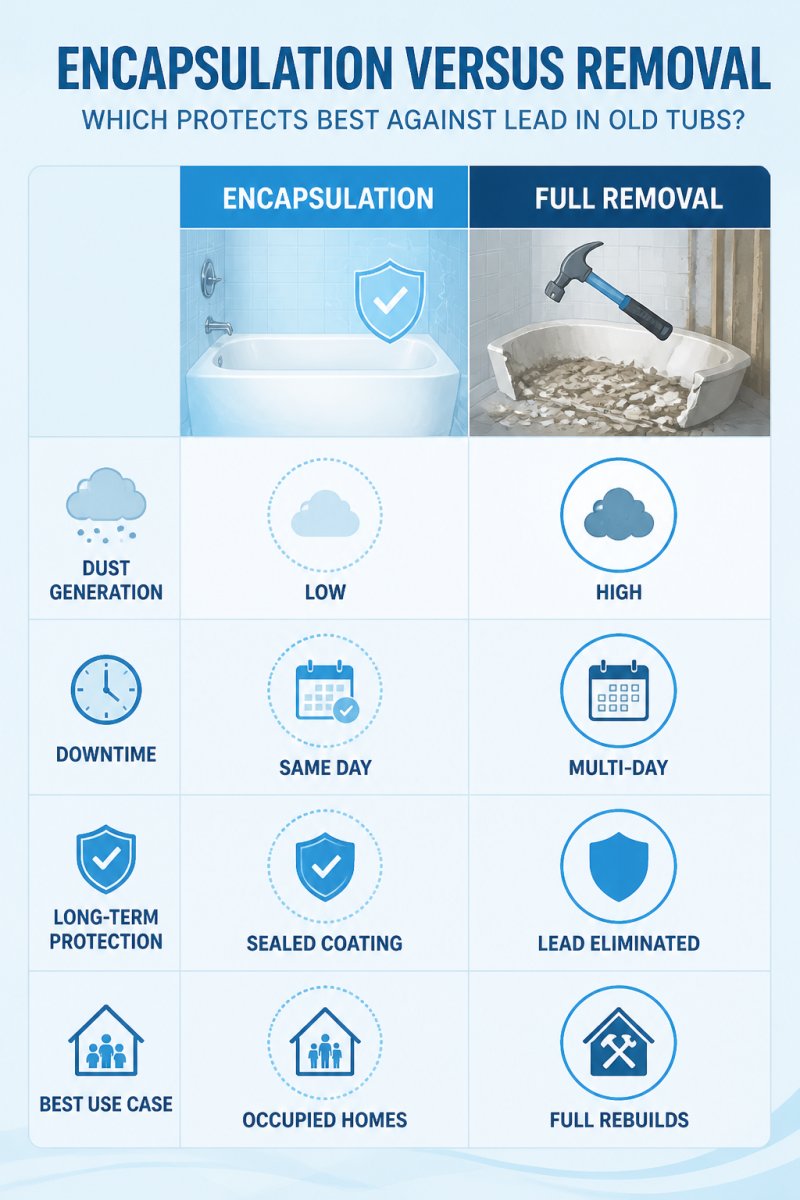
The trade-off is straightforward. Encapsulation keeps the lead in place but sealed, which is safe as long as the coating stays intact. Removal gets rid of it, but you pay for that in time, mess, and risk during the work itself. For a rental unit or a family bathroom, encapsulation can be a highly practical measure.
Choosing a Lead-Safe Refinishing Provider in Toronto
Choosing a lead-safe refinishing provider in Toronto comes down to three checks: proof of licensing and insurance, a clear containment plan, and a guarantee you can hold them to. Everything else is secondary.
Landlords with multiple units should ask about scheduling capacity up front. Century BathTubs works with residential and commercial clients across the GTA, including property investors refreshing several units, and the EP-ACRYLIC coating cures fast enough that a tub is typically back in service quickly.
A key question to ask a provider is: “How do you keep lead dust out of the rest of my home?” If they cannot answer that in specific terms, it’s advisable to continue your search.
Watch for these red flags:
- No proof of insurance when asked
- No mention of dust containment
- Pressure to start immediately without testing
- No written guarantee on the finished coating
Frequently Asked Questions
How do I know if my old bathtub contains lead?
Tubs made before the mid-1980s are the most likely to carry lead-based finishes, and cast iron tubs from the early 1900s through the 1970s are common candidates. A home test kit can flag lead on intact or worn surfaces, but the only way to confirm is a lab analysis of a paint chip. If your tub predates the 1980s and the finish is chipping or chalky, treat it as a lead risk and get it assessed before any sanding, scraping, or reglazing begins.
Is bathtub refinishing safe for family members during and after the work?
Yes, when the work is done correctly. Encapsulation coatings seal lead-bearing finishes in place instead of grinding them up into dust, which is the main exposure risk. Ask your provider how they ventilate the bathroom, what they use to clean up debris, and how long the coating needs to cure before the tub is used again. Once cured, the surface is sealed and family members can bathe normally.
Does Health Canada regulate lead in bathtub coatings?
Health Canada sets limits on lead in surface coatings and consumer products, and the agency advises that lead-based paint be managed carefully rather than sanded or burned off. For refinishing, this means choosing a coating system that seals the old finish and following safe work practices during preparation. Your provider should be able to explain how their process meets these expectations and keeps dust out of the rest of your home.
What safety precautions should professionals take when refinishing old tubs in Toronto?
Proper precautions include sealing off the bathroom with plastic sheeting, using HEPA-filtered vacuums and wet methods to control dust, wearing respirators and protective clothing, and disposing of lead-bearing debris according to Ontario waste rules. Ventilation should run throughout the job, and surfaces should be wiped down before the coating cures. Ask any provider to walk you through these steps before you book.
Lead in an old tub is a manageable problem, but only when the work is done with containment and the right coating. Century BathTubs has restored tubs across Toronto and the GTA since 1995 using a fast-curing EP-ACRYLIC system, backed by licensed and insured technicians and a three-year hassle-free guarantee. If your tub predates the 1970s and you want it refinished safely, get started with Century BathTubs and protect your family while extending the life of your fixture.