

Table of Contents
- DIY vs Professional Bathtub Reglazing: Quick Comparison
- Cost Comparison: DIY vs Professional Bathtub Reglazing
- How Long Does Bathtub Reglazing Last: Durability Explained
- Bathtub Reglazing Preparation Steps: Surface Readiness
- Is Bathtub Reglazing Toxic: Chemical Safety & PPE
- Common DIY Mistakes and Why Professional Results Last Longer
- Popular DIY Kits vs Professional Services: Pros and Cons
- Long-Term Maintenance: Protecting Your Investment
DIY vs Professional Bathtub Reglazing: Cost, Durability & Safety
Last Updated: July 11, 2026
Choosing between DIY and professional bathtub reglazing determines whether you get a quick cosmetic fix or a solution lasting a decade. This decision impacts both your wallet and your bathroom’s long-term condition. Below, we’ll evaluate both options based on cost, durability, chemical safety, and real-world performance.
DIY vs Professional Bathtub Reglazing: Quick Comparison
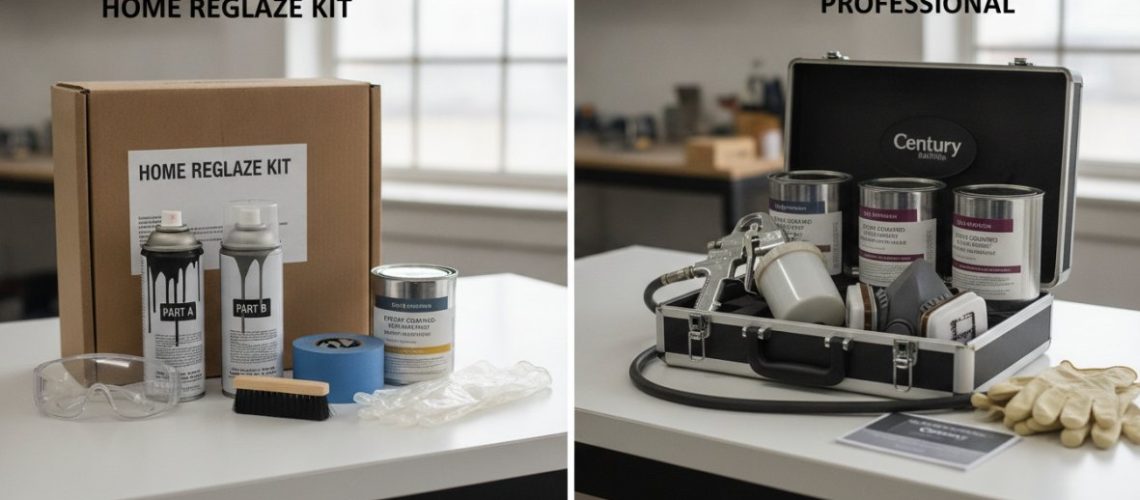
The choice hinges on three factors: upfront cost, durability expectations, and tolerance for chemical exposure. DIY kits cost significantly less but demand meticulous surface preparation and carry higher failure rates due to peeling and poor adhesion. Professional refinishing commands higher prices but delivers superior durability, warranty protection, and zero hassle.
The real difference emerges over time. DIY applications often fail within 12-18 months, especially around drains and faucets. Professional coatings using proprietary bonding agents typically last 5-10 years with proper care.
| Aspect | DIY Kit | Professional Service |
|---|---|---|
| Initial Cost | $25-$50 | Contact for quote |
| Application Time | 4-8 hours | 1-2 hours |
| Curing Time | 3-7 days | 24-48 hours |
| Durability | 1-3 years | 5-10 years |
| Warranty | None | 3-5 years typical |
| Fume Exposure | High | Controlled environment |
| Adhesion Risk | High (improper prep) | Low (professional prep) |
| Best For | Budget-conscious, patient DIYers | Durability, warranty, peace of mind |
Cost Comparison: DIY vs Professional Bathtub Reglazing
The financial gap between these approaches is stark initially, but hidden costs often tip the scales toward professional services.
DIY Kit Pricing
Rust-Oleum Tub & Tile Refinishing Kit retails between $40-$50 per quart, with most standard tubs requiring one to two quarts. Homax Tough as Tile offers a cheaper entry point at $25-$35. However, these base prices don’t reflect true project costs. Materials for proper surface preparation, sandpaper (multiple grits), TSP cleaner, primer, masking tape, and protective equipment, easily reach $100-$150 total.
Failed DIY applications force you to either accept a substandard finish or sand everything down and start over, doubling material costs and time investment.
Professional Service Pricing
Professional reglazing varies by region, tub size, and condition. Services typically cost more upfront but include labor, expertise, premium materials, and warranty coverage. Request detailed quotes specifying the coating system, surface repair scope, warranty terms, and curing time.
Hidden Costs to Consider
DIY failures carry cascading expenses. If your application peels within 18 months, you’re facing a professional refinishing job at full price with added labor to remove the failed coating. That $40 kit suddenly costs $400+ when factoring in professional correction.
Fume-related health impacts also factor into true cost. Inadequate ventilation during DIY application can trigger respiratory issues requiring medical attention. Professional applicators work in controlled environments with industrial ventilation, eliminating this risk.
Water damage from improper sealing is another hidden cost. Failed DIY coatings allow moisture to seep under the finish, potentially damaging the underlying tub structure and requiring full replacement rather than reglazing.
How Long Does Bathtub Reglazing Last: Durability Explained
A reglazing job’s lifespan depends on application method, surface preparation, coating quality, and maintenance habits.
DIY Kit Lifespan
Most DIY kits deliver 1-3 years of acceptable appearance before degradation becomes visible. Peeling typically begins at stress points: the drain area, faucet surround, and corners where water pools. Once peeling starts, it accelerates as water seeps under the coating. Within 18-24 months, most DIY applications show visible wear.
Professional Coating Durability
Professional refinishing systems deliver 5-10 years of reliable performance through superior surface preparation, industrial-grade materials, and controlled application environments. Professional technicians acid etch the surface to create microscopic texture that allows the coating to bond at a molecular level, a preparation step often skipped in DIY applications.
Professional-grade urethane and acrylic formulations contain higher solids content, superior UV resistance, and moisture barriers that DIY kits cannot match. Industrial spray equipment applies coatings in thin, even layers, ensuring consistent thickness and curing. A tub refinished professionally and maintained with proper cleaning typically lasts 7-10 years.
Bathtub Reglazing Preparation Steps: Surface Readiness
Surface preparation determines success or failure more than any other factor. This is where DIY projects most often stumble.
DIY Preparation Requirements
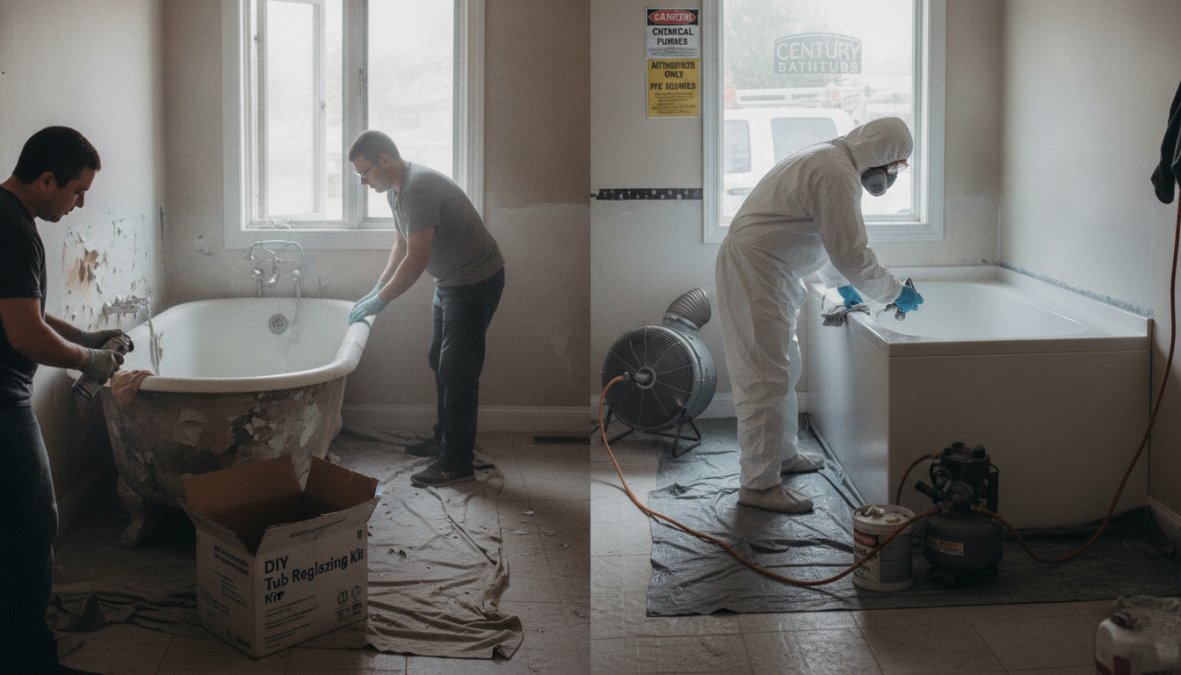
Proper DIY refinishing demands 6-8 hours of preparation work before applying coating. Start by thoroughly cleaning the tub with TSP cleaner to remove soap scum, mildew, and mineral deposits. Sand the entire surface with 120-grit sandpaper to dull the gloss and promote adhesion, then follow with 220-grit and 400-grit paper. Each grit transition requires complete dust removal and drying time.
Mask off the surrounding area meticulously using plastic sheeting to seal off the bathroom entirely. Finally, ventilate aggressively by opening windows, running exhaust fans at maximum, and considering a temporary HEPA filter unit. This step is non-negotiable for health and safety.
Professional Prep Workflow
Professional technicians complete the same steps with industrial-grade equipment and efficiency. They use commercial-strength cleaners and pressure washing to remove all contaminants. Acid etching, a step most DIYers skip entirely, chemically opens the surface to accept bonding agents, transforming it at a molecular level.
Professional masking isolates the work area completely, protecting adjacent surfaces from fumes and overspray. Ventilation systems capture fumes at the source and exhaust them outside. This meticulous preparation explains why professional coatings bond far more effectively than DIY applications.
Is Bathtub Reglazing Toxic: Chemical Safety & PPE
Both DIY and professional applications involve volatile organic compounds (VOCs) and potentially hazardous fumes, but exposure levels differ dramatically.
Fume Exposure and Respiratory Risks
Epoxy and urethane coatings release isocyanates, formaldehyde, and other respiratory irritants during application and curing. According to OSHA guidelines on chemical safety in refinishing, exposure to isocyanates can trigger asthma-like symptoms, sensitization, and long-term respiratory damage.
DIY applications in residential bathrooms create a perfect storm for overexposure. Most homeowners apply coatings in small, enclosed spaces with minimal ventilation. The applicator breathes concentrated vapors for 4-8 hours during application and multiple hours during curing.
Professional applicators work in controlled environments with industrial ventilation systems that capture fumes at the source and exhaust them outside. Curing typically occurs in an isolated space, not in the homeowner’s living area.
Required PPE and Ventilation
A proper DIY application demands serious respiratory protection: an organic vapor respirator (NIOSH-approved for isocyanates) with activated charcoal cartridges, not an N95 mask. Wear nitrile gloves, eye protection, and clothing that covers skin completely.
Ventilation requirements are strict: open all windows, run exhaust fans continuously, and consider renting a portable HEPA air scrubber. Pregnant women, people with respiratory conditions, and anyone sensitive to chemical fumes should avoid DIY refinishing entirely.
Professional Safety Standards
Professional refinishers follow strict safety protocols, wearing full-face respirators with P100 and organic vapor cartridges, protective suits, and gloves. Work areas are sealed with plastic barriers and equipped with negative-pressure ventilation systems.
Once the technician leaves, the homeowner is not exposed to curing fumes. A professional-refinished tub is typically usable within 24 hours with minimal odor.
Common DIY Mistakes and Why Professional Results Last Longer
Understanding why DIY applications fail illuminates why professionals succeed.
Peeling and Adhesion Failures
Peeling occurs when the coating loses bond with the underlying surface, typically within 6-18 months. The culprit is almost always inadequate surface preparation. Homeowners often sand lightly, skip the initial 120-grit roughing pass, or don’t sand corners and edges. The gloss surface prevents the coating from gripping.
Another common mistake is skipping acid etching entirely. This chemical process opens microscopic pores in the surface, allowing bonding agents to penetrate and lock the coating in place. Without it, the coating sits on top of the surface like paint on glass.
Dust contamination during application also causes adhesion failure. If you sand, then apply coating without removing all dust, the coating bonds to dust particles rather than the tub surface.
Professional applications prevent these failures through meticulous prep and proprietary bonding agents designed specifically for bathtub surfaces.
Application Errors and Finish Quality
Uneven application is another hallmark of DIY failure. Hand-applied coatings develop thick and thin spots. Spray application requires skill most DIYers lack, resulting in runs, drips, and thin spots.
Professional spray equipment applies coatings in precise, overlapping passes that ensure consistent thickness. Technicians adjust spray patterns based on room conditions and surface geometry, producing a uniform, high-gloss finish.
Why Professional Bonding Agents Outperform DIY Coatings
Professional bonding primers are engineered for specific substrate materials, cast iron, fiberglass, acrylic. They contain chemical compounds that bond at a molecular level. DIY kits use generic bonding agents formulated for general surfaces, which may not bond optimally to acrylic or fiberglass.
Professional-grade bonding agents also contain superior adhesion promoters and moisture barriers. They cure to a flexible finish that moves with the tub as it expands and contracts with temperature changes. DIY coatings cure more rigidly and crack under thermal stress.
Professional services offer 3-5 year warranties backed by the company’s reputation and insurance. DIY kits offer no warranty.
Popular DIY Kits vs Professional Services: Pros and Cons
Rust-Oleum Tub & Tile Kit: Budget-Friendly but High-Risk
Rust-Oleum’s two-part epoxy acrylic formula is the market leader for DIY reglazing at $40-$50. It covers up to 110 square feet per quart and dries to the touch in 1 hour.
Pros:
- Extremely cost-effective
- Readily available at major retailers
- Adequate for cosmetic touch-ups on small areas
- Fast drying
Cons:
- Requires meticulous surface preparation
- Strong chemical fumes demand serious ventilation
- High failure rate when applied by untrained homeowners
- No warranty if the coating fails
- Generic bonding agent not optimized for tub materials
Homax Tough as Tile: Beginner-Friendly Alternative
Homax’s single-part epoxy paint brushes on rather than sprays, appealing to DIYers intimidated by spray application. At $25-$35, it’s the cheapest option.
Pros:
- Straightforward brush-on application
- Lower price point
- Eliminates spray equipment concerns
- Suitable for small repairs
Cons:
- Brush strokes visible in final finish
- Durability lower than professional-grade coatings
- Prone to the same adhesion failures as spray kits
Professional Refinishing: Superior Durability and Warranty
Licensed, insured technicians handle all preparation, application, and cleanup. The coating system is engineered specifically for bathtub performance and includes a proprietary bonding primer.
Pros:
- Significantly more durable (5-10 years vs. 1-3 years)
- Professional-grade bonding agents ensure superior adhesion
- 3-5 year warranty covers failures
- Zero hassle
- Eliminates fume exposure
- Faster curing (24-48 hours)
- Licensed and insured
Cons:
- Higher upfront cost than DIY kits
- Requires scheduling and home access
The true cost of DIY reglazing includes materials, high likelihood of failure, health risks from fume exposure, and eventual professional correction. For most homeowners, professional refinishing delivers better value over the tub’s lifespan.
Long-Term Maintenance: Protecting Your Investment
How you maintain your reglazing directly impacts how long it lasts.
DIY Kit Maintenance Demands
DIY-refinished tubs require aggressive maintenance. Avoid abrasive scrubbers, scouring powders, and bleach-based cleaners. Use only soft cloths and pH-neutral cleaners. After each use, wipe down the tub to prevent standing water. Ensure the exhaust fan runs for 30 minutes post-shower to reduce humidity.
Avoid heavy impact, as the coating is more fragile than a factory finish. Even with meticulous care, DIY coatings degrade predictably, with visible wear within 12-18 months.
Professional Coating Care and Warranty Coverage
Professional coatings are more forgiving. You can use standard bathroom cleaners without fear of degrading the coating. The finish is harder and more scratch-resistant than DIY applications.
Regular cleaning prevents soap scum and mildew buildup, but the coating tolerates normal use without special precautions. Most professional coatings last 7-10 years with standard maintenance.
Warranty coverage protects your investment. If the coating fails during the warranty period, the professional service re-coats the tub at no cost. This guarantee reflects the company’s confidence in the product and application quality.
The decision between DIY vs professional bathtub reglazing ultimately reflects your priorities: budget, durability, and peace of mind. DIY kits appeal to budget-conscious homeowners willing to invest time and accept higher failure risk. Professional services cost more upfront but deliver durability, warranty protection, and zero hassle.
For most homeowners, professional refinishing represents better long-term value. Century BathTubs has been serving the Toronto and GTA area since 1995, helping customers save thousands of dollars by restoring worn tubs with our durable EP-ACRYLIC coating system. Our licensed, insured technicians complete the job in 1-2 hours with a three-year guarantee. Get a free inquiry today and discover how professional reglazing can restore your bathroom without the cost or disruption of replacement.
Frequently Asked Questions
How long does a DIY bathtub reglazing kit last compared to professional services?
DIY kits typically last 1-3 years before peeling or deterioration occurs, depending on surface prep and application quality. Professional bathtub reglazing with proper bonding agents and epoxy coatings can extend durability to 10-15 years. The difference stems from superior adhesion, material quality, and expert surface preparation that DIY applications rarely achieve.
Is bathtub reglazing toxic, and what safety precautions do I need?
Yes, both DIY kits and professional reglazing involve chemical fumes from epoxy or urethane finishes. DIY users must wear a respirator, ensure continuous ventilation, and avoid inhaling fumes during application and curing. Professional technicians follow strict safety protocols, use industrial-grade ventilation systems, and possess proper training to minimize exposure. If you have respiratory sensitivity, professional application is safer.
What are the main preparation steps for bathtub reglazing, and why do they matter?
Critical preparation includes cleaning, acid etching (to improve adhesion), sanding, and priming. DIY kits require meticulous prep to prevent peeling, any missed steps lead to coating failure. Professional technicians use specialized equipment and bonding agents to ensure proper surface preparation, which is why their results last longer and adhere better than most DIY attempts.
Is DIY bathtub reglazing worth the money saved?
DIY kits cost significantly less upfront, but often fail within 1-3 years, requiring costly replacement. Professional reglazing costs more initially but provides a 10-15 year lifespan and warranties. When you factor in durability, maintenance, and the risk of failure, professional services typically offer better long-term value, especially for older cast iron or fiberglass tubs.
Can you reglaze a bathtub that has already been reglazed?
Yes, but it's challenging. If a previous DIY coating is peeling or failing, the old finish must be completely removed before reapplication. Professional refinishers have the tools and expertise to strip old coatings and properly prepare the surface for a new finish. Attempting to reglaze over a failed DIY coat will likely result in the same peeling problem.
This article was written using GrandRanker